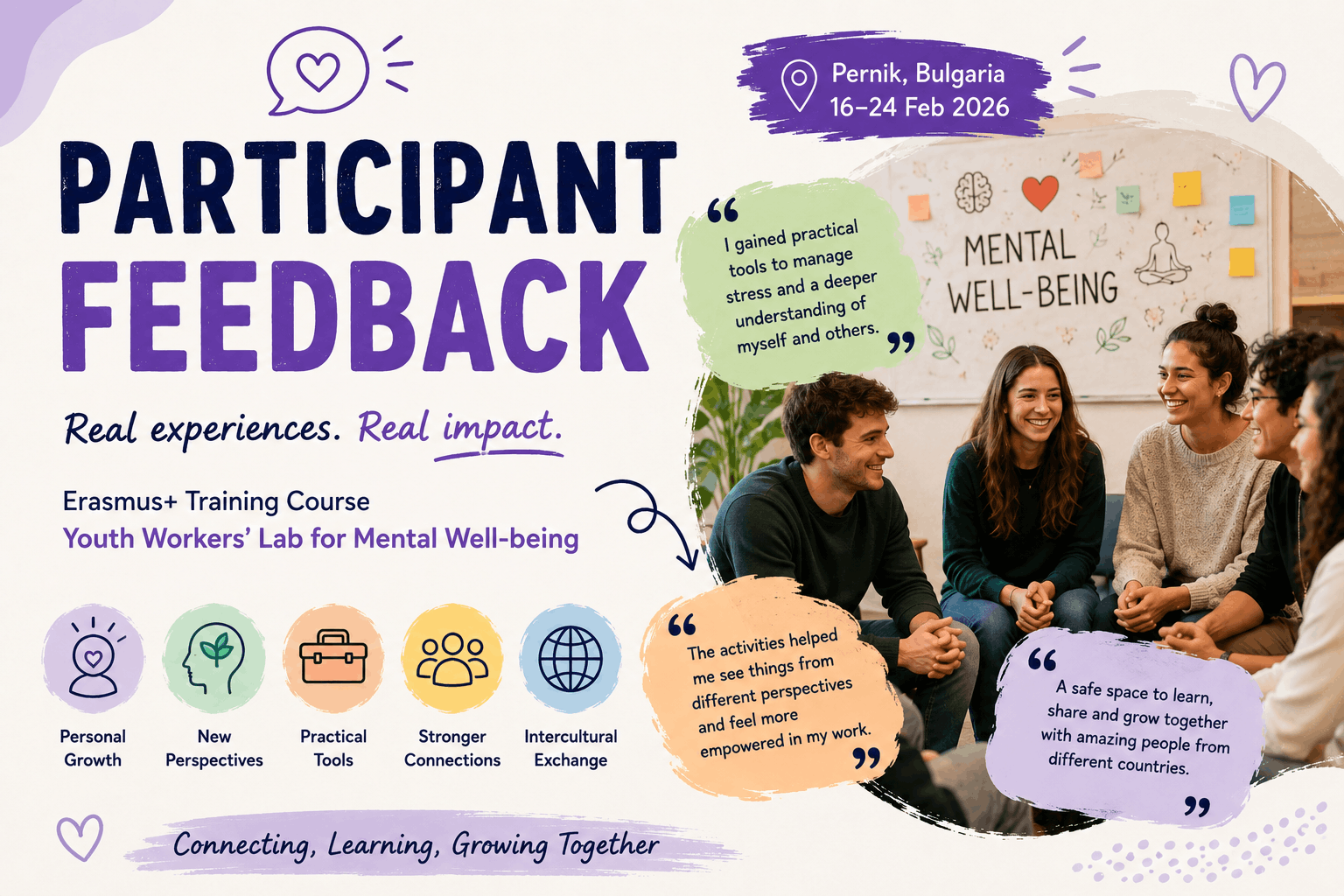
Laura described the Erasmus+ training course “Youth Workers’ Lab for Mental Well-being” as a deeply meaningful and transformative experience that helped her overcome personal fears while discovering the value of intercultural connection and emotional openness. Although she had previously attempted to participate in an Erasmus+ project during her university years without having a positive experience, she explained that she always felt a strong desire to be part of an international and multicultural environment. Participating in the training course in Pernik finally gave her the opportunity to experience exactly that in a supportive and authentic way.
For Laura, one of the most important aspects of the project was the possibility to engage in deep and honest conversations about mental well-being — a topic she considers extremely important for young people today. Through discussions, workshops, and group activities, participants explored emotional health, stress, self-awareness, and interpersonal relationships while creating a safe environment where everyone could openly share emotions, personal experiences, and cultural perspectives. She emphasized that the project went beyond simply exchanging ideas; it created genuine emotional connections and moments of vulnerability that helped participants truly get to know one another.
Reflecting on her personal growth, Laura shared that the project helped her become more confident and self-aware. Living in a foreign country with people she had never met before initially pushed her outside her comfort zone, but over time she realized that she already possessed inner resources that allowed her to adapt, connect with others, and feel emotionally safe even in unfamiliar situations. The experience also encouraged her to reflect more deeply on her routines, priorities, personal growth, and emotional resilience. Meaningful conversations with participants from different countries challenged some of her previous ways of thinking and inspired her to become more open to new experiences and perspectives.
Laura explained that this transformation happened because she consciously chose to confront situations she would normally avoid due to anxiety or fear. Stepping outside her comfort zone became one of the most important learning outcomes of the project. As a concrete follow-up action, she plans to continue seeking new international opportunities and multicultural experiences where she can contribute meaningfully both locally and at the European level. She also intends to organize a dissemination activity at the University of Florence in Florence in order to share her experience and raise awareness among students about Erasmus+ opportunities and the positive impact such projects can have on young people’s lives.
Among the most useful tools Laura discovered during the training were breathing techniques, meditation practices, the Wheel of Emotions, and the Mental Health & Emotional Resilience Worksheet. She described breathing exercises and meditation as practical tools that help people remain grounded and present when facing stress or anxiety. The Wheel of Emotions particularly stood out to her as a powerful method for self-reflection and emotional communication because it helps individuals better identify and express their feelings. Laura believes this tool can be especially beneficial in youth work settings by helping young people better understand their emotions, reactions, and internal experiences. She also plans to continue using the resilience worksheet as a personal reflection tool for emotional growth and self-awareness.
Laura strongly encourages other young people to participate in Erasmus+ projects, especially during periods of personal development and identity formation. According to her, these experiences offer much more than professional skills or international travel opportunities — they help young people challenge personal limits, develop intercultural understanding, build confidence, and create meaningful human connections. She believes schools and universities should actively promote such initiatives because Erasmus+ projects contribute significantly to personal growth, emotional awareness, and social development, leaving a long-lasting and positive impact on participants.
Funded by the European Union. Views and opinions expressed are however those of the author(s) only and do not necessarily reflect those of the European Union or the European Education and Culture Executive Agency (EACEA). Neither the European Union nor EACEA can be held responsible for them.