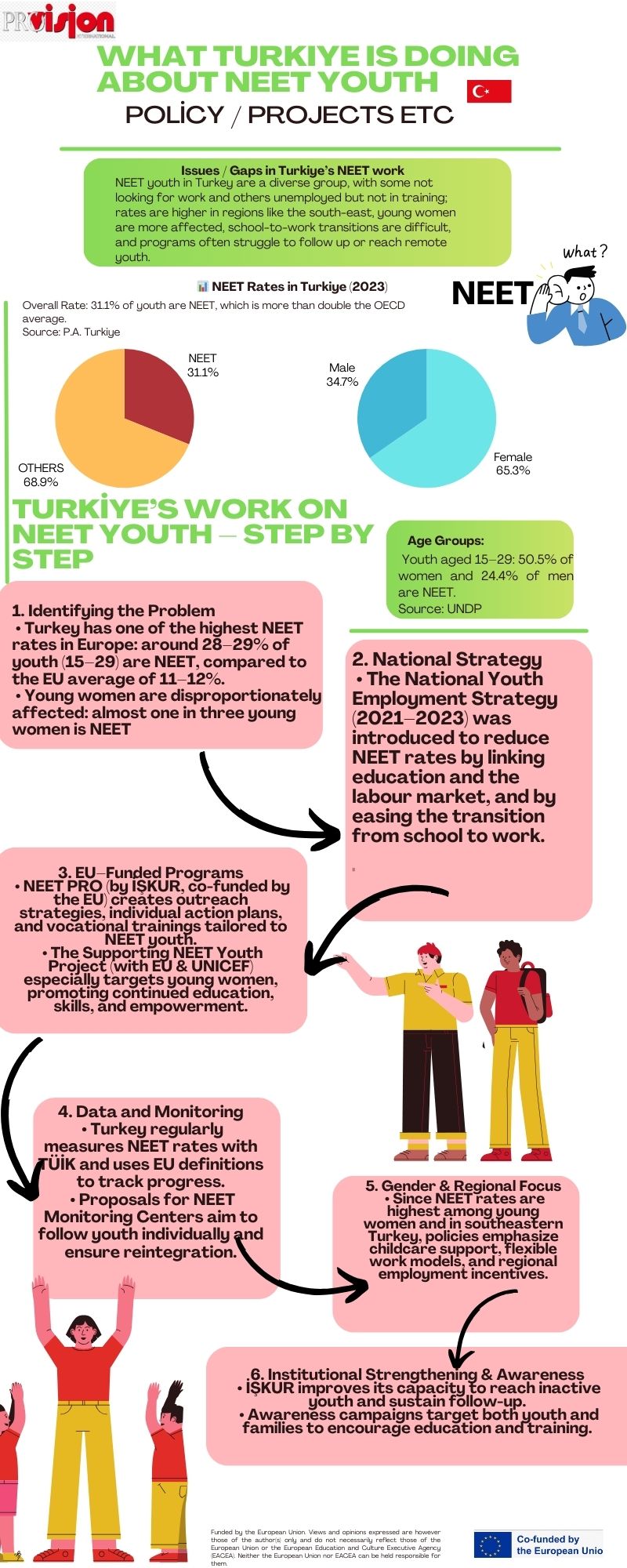
Against this European backdrop, Türkiye faces an even more pronounced NEET challenge. According to 2023 data, 31.1% of young people in Türkiye are classified as NEET, a rate that is more than double the OECD average. The situation is especially critical for young women, who account for over 65% of the NEET population, and for youth living in economically disadvantaged or remote regions, particularly in the south-east of the country.
NEET youth in Türkiye are a highly diverse group. While some are actively seeking employment, others are discouraged, informally employed, or disconnected from both education and labour market services. Structural challenges such as difficult school-to-work transitions, limited access to quality vocational training, regional inequalities and childcare responsibilities disproportionately affect young women and contribute to long-term inactivity.
Policy Responses and Programmes in Türkiye
In response, Türkiye has taken a step-by-step policy approach to addressing NEET youth, aligning parts of its strategy with EU standards and definitions. The National Youth Employment Strategy (2021–2023) was introduced to strengthen links between education and the labour market, improve employability, and facilitate smoother transitions from school to work.
A key role is played by İŞKUR, the Turkish Employment Agency, which implements several EU-funded and nationally supported programmes. Initiatives such as NEET PRO, co-funded by the European Union, focus on outreach strategies, individual action plans and vocational training tailored specifically to NEET youth. In parallel, projects implemented with international partners, including UNICEF, place a strong emphasis on young women, continued education, skills development and empowerment.
Türkiye has also invested in data collection and monitoring, regularly measuring NEET rates through TÜİK and applying EU-compatible definitions to track progress. Proposals for dedicated NEET monitoring centres aim to ensure individual follow-up, early intervention and sustainable reintegration pathways. Additionally, recent policies increasingly recognise the importance of a gender- and region-sensitive approach, including childcare support, flexible work models, regional employment incentives and awareness-raising campaigns targeting both young people and their families.
Bridging European Best Practices and National Action
Taken together, the two infographics highlight a shared understanding: reducing NEET rates requires coordinated, long-term and inclusive strategies. The EU experience demonstrates the value of early intervention, strong public employment services, quality training offers and sustained funding. Türkiye’s evolving approach shows how these principles can be adapted to a different socio-economic context, with particular attention to gender inequality, regional disparities and institutional capacity building.
For civil society organisations, youth workers and policy stakeholders, this comparison underlines the importance of transferring and localising EU best practices, strengthening cross-sector cooperation and ensuring that no young person remains invisible to support systems. Addressing the NEET challenge is not only an employment issue – it is a matter of social cohesion, equal opportunity and the future resilience of our societies.